







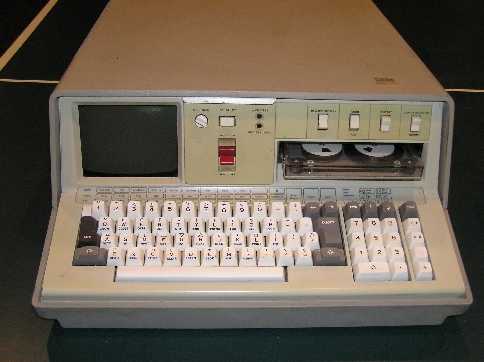


IBM 5100 Portable Computer


Memory capacity

Programming Language

APL

BASIC

Both

16 Kbytes

A1

B1

C1

32 Kbytes

A2

B2

C2

48 Kbytes

A3

B3

C3

64 Kbytes

A4

B4

C4


IBM 5100
IBM 5100


Introduced in 1975, the 5100 was
IBM's first production personal
computer (six years before the PC!).
The 5100 has an integral CRT
display, keyboard, and tape drive.
It was available with APL, BASIC, or
both, and with 16, 32, 48, or 64
Kbytes of RAM.

Display:
The 5100 has an internal CRT (five inch diagonal) which displays 16 lines of 64
characters. Because the characters are so small, IBM provided a three-position switch
to allow the user to select the display of all 64 characters of each line, or only the
left or right 32 characters (interspersed with spaces).
Normally the display is generated from the buffer in main memory at addresses
0x0200..0x05ff. There is a front-panel switch which makes the unit display the first
512 bytes of main memory (addresses 0x0000..0x01ff) in hexadecimal for diagnostic
purposes, mainly to observe the processor registers.

Mass storage:
Mass storage was provided by a quarter-inch cartridge tape drive using DC300 cartridges
to store 204 Kbytes. Tapes were written in 512-byte records. There are several file
types including BASIC programs, APL workspaces, and data.

System Software:
On a 5100 with both languages, the user's choice of language is selected by a toggle
switch on the front panel!
Instead of being written in the native micro code instruction set of the processor, the
5100's language interpreters are written for more sophisticated "virtual machines", and
the micro code emulates those machines. This was done in order to economize on the
amount of ROS needed to implement the language interpreters, and perhaps to speed the
product development. The APL micro code emulates a subset of the System/360 instruction
set, while the BASIC micro code emulates the System/3.
The APL interpreter was derived from APLSV.

Logic:
Most of the logic circuitry in the 5100 is built using a TTL-compatible 134-gate
bipolar gate array technology called "Dutchess". Each chip has 60 three input NAND
gates, 40 four-input NAND gates, and 34 two-input NOR off-chip drivers. The gate
propagation delay times are about 10 ns. The chips are packaged in square metal cans.

Processor:
The 5100 uses a board-level microprocessor called "PALM" (for "Put All Logic in Micro
code"), generally referred to as the "controller" in IBM documentation. The board
contains thirteen of the square metal-can packages, along with three conventional
DIP-packaged parts and one round metal can part.
PALM uses 16-bit vertical microinstructions. The average microinstruction execution
time is 1.75 µs.
Microinstructions can directly reference sixteen 16-bit general-purpose registers.
Register zero is the microinstruction pointer, also known as the program counter. There
are four banks of registers, one bank per interrupt level, for very fast interrupt
context switching. The four banks of registers are also addressable as the first 128
bytes of RAM. (The first 128 bytes of the actual RAM cards is not available.)
There are three interrupts, so there are four processor levels, 0-3, with level 0
executing when no interrupt is pending. Since each level has its own program counter,
there is no concept of an interrupt vector. The processor will remain at a given level
as long as the hardware interrupt request for that level is active (and no higher-level
request is active). Interrupt handlers are thus normally written as loops.
The ALU is eight bits wide. Despite the fact that the registers are 16 bits wide, PALM
provides few 16-bit arithmetic or logical operations. However, some 8-bit operations
may cause a carry or borrow from the high byte of a register.
The processor has a 16-bit address bus. The memory is byte-addressable, for a maximum
directly addressable capacity of 64 Kbytes. Each byte of memory has a parity bit, so
the memory data busses are 18 bits.
Branches can be effected any instruction which writes or alters register zero. One
particularly interesting trick allows the creation of a single-instruction infinite
loop by clearing register zero. In this case, register zero serves both as the program
counter, and as the instruction word pointed to by the program counter. An all zeros
word decodes as an instruction to subtract two from register zero. After the
instruction is fetched, the PC is incremented by two, then the instruction subtracts
two from it again, leaving it at zero. This single-instruction loop technique was used
when code running at level zero (non-interrupt) needed to wait for an interrupt to be
serviced. The interrupt handler would then write a new value to location zero, which is
NOT the interrupt handler's PC, since the handler is running at a non-zero level. Once
the hardware interrupt is cleared, level zero gets control again starting from the new
PC value.

Read Only Storage (ROS):
There are three kinds of ROS (more commonly known as ROM or Read Only Memory) in the
5100.
The "control ROS" is part of the PALM processor and is used to decode the
microinstructions. It is organized as 256 words of 32 bits.
The "executable ROS" is directly addressable by the processor, and contains the
microinstructions that are directly executed. There is 16K*18 of micro code for the
diagnostic and bring-up routines, I/O supervisor and control routines, and the virtual
machine interpreter for BASIC. Another 16K*18 of micro code provides the virtual
machine interpreter for APL.
The "non-executable ROS" is accessed as an I/O device by the processor, and contains
the code interpreted by the virtual machines, namely the APL and BASIC language
interpreters. The non-executable ROS uses n-channel MOSFET chips storing 48 Kbits each,
with an access time of approximately 2 µs.
The non-executable ROS is divided into three regions:
- Common ROS, on the ROS control module, 18 Kbytes
- BASIC ROS, on one ROS module, 36 Kbytes
- APL ROS, on three ROS modules, 96 Kbytes

Read/Write Storage:
The RAM memory consists of one to four pairs of boards of 8 Kbytes each, using NMOS RAM
chips and separate bipolar drivers and sense amplifiers. The Roberson articles claim
that the memory is implemented using 1 Kbit MOSFET RAM chips, but it appears that they
actually use 2 Kbit chips. Each board has nine RAM modules, each of which apparently
contains four chips. This memory has an access time of approximately 300 ns, and a
cycle time of approximately 450 ns.
Display Controller:
The display controller is the only 5100 device to use Direct Memory Access (DMA), which
IBM refers to as "cycle-stealing". The display is memory mapped. Microcode can disable
the display during calculations in order to make more memory bandwidth available to the
processor.

Predecessor:
The 5100 was based on the design of an earlier proof-of-concept system called SCAMP,
for "Special Computer, APL Machine Portable". SCAMP was also based on the PALM
processor, but used a Norelco (Philips) compact cassette drive instead of the 3M
cartridge. SCAMP emulated an IBM 1130 minicomputer in order to run APL\1130. SCAMP is
in the Smithsonian Institution.

Follow-ons:
The 5100 product line was later expanded to include the 5110, which supported external
8-inch floppy disk drives, and the 5120 with built-in floppy drive. The 5120 also seems
to be known as a 5110 Model 3.
In 1980 IBM introduced the System/23 DataMaster, based on the Intel 8085 processor.
In 1981 IBM introduced the IBM PC, Type 5150, based on the Intel 8088 microprocessor.
Although there had been many personal computers before, the introduction of the IBM PC
finally was seen in the corporate world as validating the concept. To this day, over
90% of desktop computers are still largely compatible with the original IBM PC.


Models: