






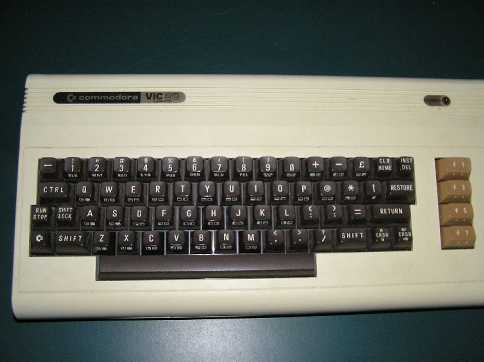



NAME  

VIC 20

MANUFACTURER  

Commodore

TYPE  

Home Computer

ORIGIN  

U.S.A.

YEAR  

May 1981

END OF PRODUCTION 

January 1985

BUILT IN LANGUAGE 

CBM Basic V2

KEYBOARD  

Full-stroke keyboard, 4 function keys, 66 keys

CPU  

Commodore Semiconductor Group 6502A

SPEED  

1.0227 MHz

COPROCESSOR  

VIC-I (6560) for sound and graphics.

RAM  

5 KB (3583 bytes free), expandable up to 32 KB

VRAM  

(shared regular RAM)

ROM  

16 KB═

TEXT MODES 

23 rows x 22 columns

GRAPHIC MODES 

184 x 176

COLORS  

8 character colors, 16 background/border colors

SOUND  

3 voices / 3 octaves

SIZE / WEIGHT 

40.3 x 20.4 x 7.2 cm / 1,8 Kg

I/O PORTS 

1 joystick port, 1 user port, 1 serial port, 1 cartridge port, RGB output, tape interface

POWER SUPPLY 

External power supply unit, 18 Watts

PRICE  

$299.95 (1981, U.S.A.)


Commodore VIC-20
Commodore VIC-20

The VIC-20 is a "family" version of
the PET series (using the same
microprocessor and Basic language).
It was the first computer to sell
more than one million units. Once
dubbed the MicroPET during the 1980
Computer Electronics Show, it later
became known as the VIC-20. VIC
referenced the VIC-I (Video
Interface Chip) chip used for
graphics and sound. There does not
seem to be any obvious rationale
behind the usage of the number 20, other than the fact that it was close to the 22
characters per line and to the combined RAM and ROM memory in the machine (5 KB RAM +
16 KB ROM).

Regarding the name, Michael Tomczyk, (manager of the VIC project) recalls:
"VIC sounded like a truck driver, so I insisted on attaching a number. I picked number
20 and when Jack Tramiel asked, "Why 20?" I replied, because it's a friendly number and
this has to be a friendly computer." He agreed. The number 20 has no relation to any
technical feature just an idea of a friendly sounding number. That sounds a bit bizarre
looking back on it, but we did a lot of things by instinct in those days."

The VIC-20 was designed by Bob Yannes who also created the SID chip for the C64. He
later joined Ensoniq to design synthesizers.

The Video Interface Chip (or VIC as it is commonly called) is one of the most important
silicon chips in the VIC-20 microcomputer, coming second only to the 6502A
microprocessor itself. The VIC is a specially constructed input-output (I/O) chip that
offers a large variety of functions, but as suggested by its name, is primarily
concerned with the production of the video output signal. It was originally intended to
be sold to third-party manufacturers for use in video game machines. Demand for the
chip was low, and so Commodore decided to make their own system to recoup their losses.

The VIC-20 was initially launched in Japan in late 1980 (under the VIC-1001 name) with
a Japanese 'Katakana' set of characters. It was subsequently released in North America
in May of 1981. Though these are the "official" release dates, several prototypes of
the Commodore VIC-20 were reportedly available in late 1979. These early machines
offered only 4 KB of RAM and used a different set of game cartridges.

Thanks to the colorful graphics and low cost, the VIC-20 was an immediate success. At
its peak, more than 9000 units rolled off the assembly line each day. Adding to its
success was the fact that it was the first color computer to break the $300 (USD) price
barrier.

A wide range of peripherals and software were developed for the VIC-20. The failed
Commodore 16 eventually became the successor of the VIC-20.